
Your home is served by a heat network. Heat networks provide an efficient and environmentally friendly way of delivering energy to buildings. Instead of every home needing its own gas or electric boiler, a central plant room generates energy into heating, hot water, and sometimes cooling, which is then supplied to all connected properties. This ‘What is a heat network’ video by the Department for Energy Security & Net Zero (DESNZ) provides more in-depth information on how heat networks operate and the benefits they bring to communities.
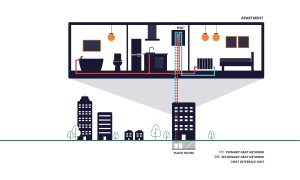 |
Your heat network is managed by your heat supplier. Your heat supplier, or building owner, manages the incoming bulk fuel supply to the central plant room, which is then used to produce heating & hot water via either gas or electric boilers, combined heat and power (CHP) units, air source heat pumps or ground source heat pumps.
From the plant room, hot water is distributed through a network of insulated pipes to a heat interface unit (HIU) installed in each property. This ensures a reliable and efficient supply of heating & hot water, delivered to your home as and when you need it.
Your HIU is connected to room thermostats and programmers, giving you full control over your energy use. A heat meter linked to your HIU measures the amount of heating & hot water you consume, so you only pay for what you use. To learn more about where the network meets you, we recommend DESNZ video on HIUs.
Where we provide billing services for cooling, you may also have a cooling interface unit (CIU), delivering cooling services alongside heating & hot water.
Please note, if you’re connected to a district heat network then the energy centre may be located outside of your development.
Cost savings
Because your building is connected to a shared heat network instead of using individual boilers in each home, the overall set-up is simpler and more efficient. This can help reduce maintenance and running costs over time, which supports keeping heating charges fair for residents.
On-demand heating
On a heat network, heat is typically stored in thermal stores and constantly recycled and circulated through the network, so there’s no need to wait for a boiler to heat up. That means faster access to hot water and a more responsive, consistent heating experience in your home.
Cleaner air, healthier living
Heat networks are designed to be more environmentally friendly than traditional heating systems. By using shared heating equipment and low-carbon energy sources, they help reduce carbon emissions – which is better for the planet and future generations.
Supports a greener future
Heat is generated centrally on a heat network, which means switching from carbon intensive heating sources to more environmentally friendly ones, like air source heat pumps, is easy. This means your heating system can become more environmentally friendly over time, without any disruption to you.
Several organisations may be involved in the day-to-day operation of your heat network. We understand this can get confusing so here’s a simple overview of the roles and responsibilities of each one:
- Heat supplier: This may be your landlord, managing agent or ESCo Manager. They ensure you receive reliable heating & hot water, manage the bulk fuel procurement, and set your energy tariffs to cover the operational costs of running the heat network.
- Building landlord: This is who owns the building you live in. If no managing agent or ESCo Manager is appointed, they will also act as the heat supplier (see above).
- Managing agent: A managing agent may have been appointed by your heat supplier or landlord to look after the daily operations of the building, including the heat network. If appointed, they’ll handle the tasks required of a heat supplier (see above).
- ESCo Manager: This is where Insite Energy have been appointed to oversee the heat network on behalf of the heat supplier. In turn, we are responsible for the incoming heat supply, bulk fuel procurement, tariff calculation and setting, and network maintenance, including the metering system.
- Metering & billing provider (e.g. Insite Energy): Reads your meter, calculates your bills, processes payments or top-ups, sends welcome information and provides customer support for billing or account issues.
- Maintenance provider: Carries out repairs and services on heat network equipment (communal systems and/or your HIU), as instructed by the heat supplier (or appointed representative).
You can see who your heat supplier, metering & billing provider and, where applicable, your maintenance provider are, along with their contact details, by searching for your home in our development directory.
For a more detailed breakdown of the different organisations involved and when to contact them, read our blog – ‘Navigating your heat network: who’s responsible for what?’.
For more details about Insite’s role, please read our ‘Our services’ guide.


Can’t find what you’re looking for?
If you still need help, please give us a call. To find your dedicated scheme phone number, simply search for your development name or postcode in the top search bar.
You can also contact us via one of our webforms for support with your Insite account.